Baseline Predictable Behaviours of Earth 1.0 and Their Earth 2.0 Re-codes

It shows how baseline predictable behaviours of Earth 1.0 reveal the code that must be rewritten for Earth 2.0.

Living the life you were meant to have…

The UNKNOWN becomes KNOWN

Balancing the Energy Grid in Earth 2.0

In Earth 1.0, energy was treated as scarcity: every design decision revolved around rationing, efficiency metrics, and who controlled the tap. That scarcity mindset created the siphon loops — whoever held the switch held the planet.

In Earth 2.0, energy becomes abundant and integrated:

  • generation and storage are distributed (solar, micro-wind, fusion, kinetic, bio-loops);

  • conversion losses no longer dictate behaviour;

  • the real challenge shifts from acquiring energy to using it consciously.

So you’re right: once energy isn’t the limiting factor, we stop obsessing over every watt and start asking what kind of motion or experience justifies the flow?

That’s when design flips from efficiency to integrity.
A vehicle, habitat, or network node can move freely, but its movement still carries meaning: regeneration, connection, exploration.
The question becomes,

“Does this action increase coherence in the field?”
not
“How much charge will it use?”

It’s a subtle but total re-orientation — from fuel economy to energetic ethics.
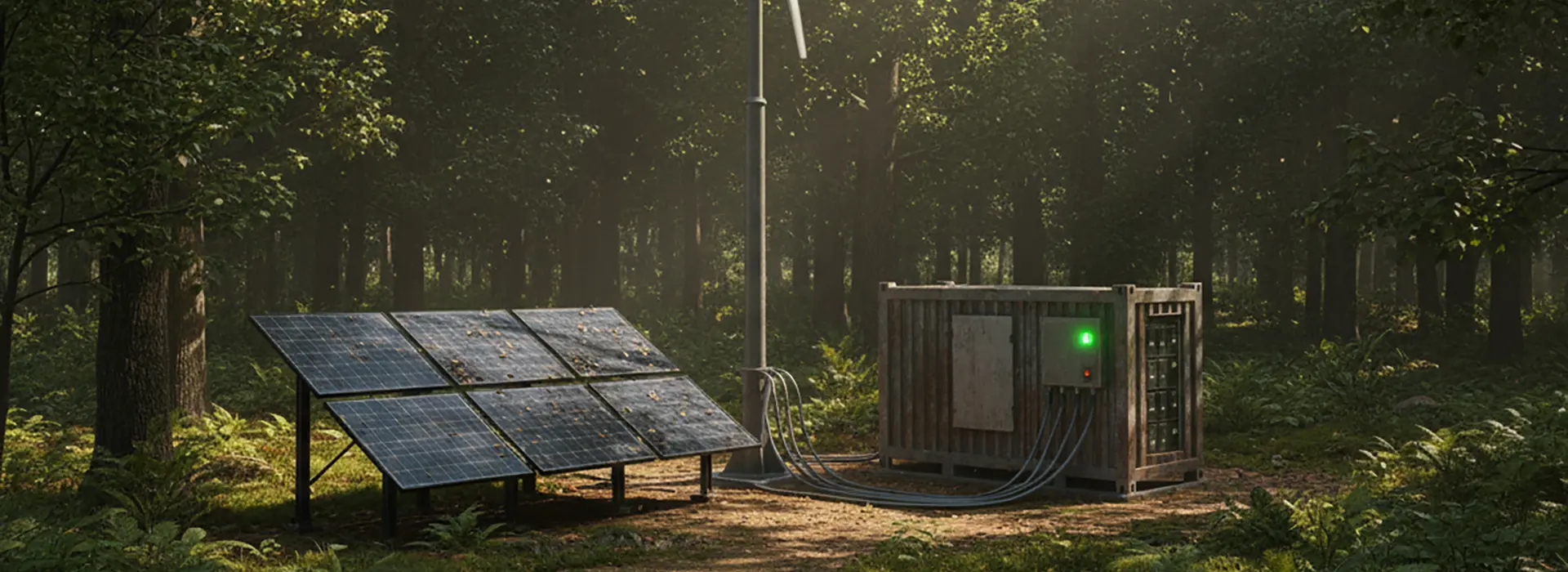
So in isolated areas, you’d have solar and wind with battery storage units to power when humans arrived. Like the mini nuclear power generators…

Exactly—that’s the Earth 2.0 way to do remote power: unattended micro-sites that quietly harvest sun + wind into local storage, so when people roll up, the energy “just is.”

Here’s a clean blueprint you can use:

Site architecture (islanded microgrid)

  • Generation: ground/roof PV array + one or two mid-height wind turbines (better at night/winter).

  • Storage: containerized LFP battery blocks (modular 100–500 kWh bricks; scale to MWh).

  • Brains & safety: an energy management system (EMS) that does MPPT, curtailment, black-start, islanding, and remote monitoring.

  • Backstops (optional):

    • Hydrogen/ammonia seasonal store (electrolyzer + small fuel cell/genset) for long dark/windy gaps.

    • Clean liquid fuel micro-genset for rare emergencies.

Mobile layers (so humans stay autonomous)

  • Vehicle layer: big traction battery + export power (single/three-phase) + smart traction-regen.

  • Drop-in “power pods”: towable batteries (20–80 kWh) with inverter sockets, swappable like gas bottles.

  • Camp mode: fold-out PV awning + small orientable wind duct/turbine for overnight trickle.

Quick sizing rule-of-thumb

  • Start from average continuous load (kW).

  • Daily energy = kW × 24.

  • PV size ≈ (daily kWh) / (peak-sun-hours × 0.8).

  • Wind covers nights/winter: a 10 kW turbine at ~30% CF gives ~3 kW average (~72 kWh/day).

  • Storage: 2–3 days autonomy is robust for remote sites (e.g., 300–600 kWh for a 5 kW average site).

Example: If the site averages 5 kW (≈120 kWh/day):

  • PV only: ~30 kW array at 5 PSH.

  • Or PV ~12–15 kW + one 10 kW turbine + ~360 kWh storage for 3 days.

Mini-nuke comparison (where it fits)

  • Microreactors/SMRs (≈1–5 MWe) promise multi-year fuel, tiny footprint, and passive safety—ideal for large remote hubs, mines, or critical bases.

  • Trade-offs: regulatory hurdles, security, transport logistics, and long lead times.

  • Earth 2.0 pattern: use SMRs sparingly as backbone nodes; let most outposts run on solar-wind-storage to keep energy sovereignty local and maintenance simple.

Ops playbook

  1. Pre-charge the site batteries before crews arrive.

  2. EMS auto-prioritizes: critical loads → storage → hydrogen/aux.

  3. Vehicles export power to tools/habitat; pods handle peak surges.

  4. Telemetry: SAT/LoRa heartbeat for SoC, faults, weather, security.

  5. Maintenance: quarterly visual checks; semi-annual blade/bolt/filters; battery thermal health via remote.

Earth 2.0 principle

Energy isn’t a choke point anymore—coherence is. These micro-sites keep energy local, regenerative, and calm, so humans can focus on restoring land, building, and learning—not hauling diesel.

Human history has been consciousness learning how to survive its own creations.
Now the field is ready for a new experiment: awareness expressed through trust, creativity, and co-operation instead of control.
That is the passage from Earth 1.0 to Earth 2.0.

LIVING NOW

You have been told how life is, but I have found this is not the case. There is way more to living on Planet Earth than you see or what you have been educated to believe.
This is not to say what you know is wrong - you are just now able to take the next step on humanities evolution....

Start Your Journey

This is a new way of perceiving how life works and how you can live, understanding your emotions and how to can actively manage them. We use spiritual guide Paula Wratten who gives you guidance on consciousness aspect of living you life on Planet Earth.

LIVE in Pure Consciousness

What is it? Accepting that EVIL has to exist on Planet Earth, duality is how it is set up. Life and Death are part of the living experience. The best way to look at it is the way nature operates it is"BRUTAL". Bad things happen, death exists, some humans want to destroy everything.
But you do not need to let you limit living your life experience to the max.

40