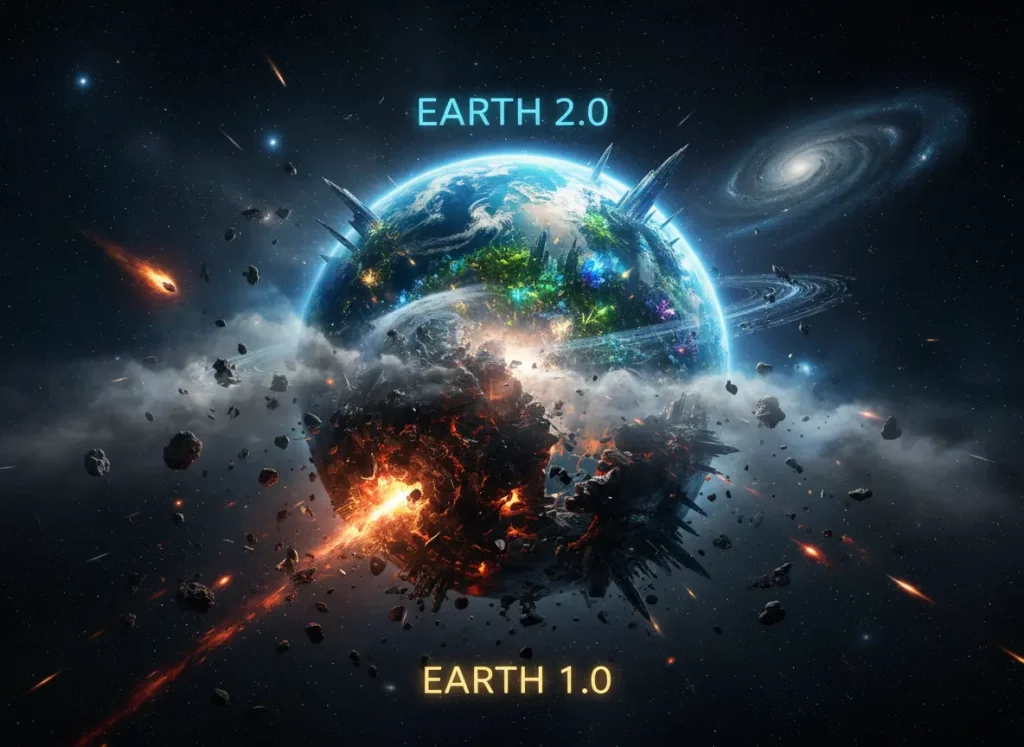
Living the life you were meant to have…
The UNKNOWN becomes KNOWN
Historical Windows Where the Earth 1.0 → Earth 2.0 Fork Existed
The Pattern First (so the timeline makes sense)
Every genuine fork appears when all four conditions briefly align:
Relative abundance (basic needs broadly met)
Low existential threat (no immediate survival pressure)
Coordination capacity (infrastructure, administration, knowledge)
Choice point:
→ Do we relax control, or formalise it?
Earth 2.0 requires relaxation of conditional survival.
Earth 1.0 always chose formalisation of control.
Now the windows.
1. Early Agrarian Stabilisation (≈ 8,000–5,000 BCE)
What had emerged
Reliable agriculture
Seasonal surplus
Predictable cycles
Small-scale storage
This is the first fork.
The choice
Option A: treat surplus as communal buffer
Option B: treat surplus as leverage
What happened
Surplus became owned, guarded, rationed.
Control structures emerged immediately.
Why Earth 2.0 didn’t emerge
Scarcity memory was too fresh
Trust had not yet been relearned
Fear of starvation dominated design
👉 Understandable miss. This was too early.
2. Classical Antiquity (≈ 500 BCE – 200 CE)
Why this window matters
This is the first time humanity had:
surplus
philosophy
governance theory
leisure for non-survival thought
Athens, Rome, Han China, India — all hit this window independently.
The fork
Humans began asking:
What is a good life?
What is justice?
What is work for?
The choice
Extend citizenship + security broadly
Or restrict security to classes
What happened
Slavery institutionalised
Survival decoupled only for elites
Work dehumanised for the many
The critical miss
Survival was not universalised.
Earth 2.0 requires:
baseline security for all, not philosophical clarity for a few.
3. Post–Black Death Europe (≈ 1350–1450)
This is one of the clearest forks.
What changed overnight
Massive population reduction
Labour suddenly scarce
Wages rose naturally
Peasants gained leverage
Feudal control weakened
For a moment:
survival was less conditional
humans could refuse work
power briefly decentralised
The fork
Allow self-regulation to stabilise
Or reassert control artificially
What happened
Laws to cap wages
Laws to bind workers
Re-criminalisation of refusal
This is Earth 1.0 explicitly reversing an Earth 2.0 drift.
👉 This was a preventable lock-in.
4. Early Industrial Abundance (≈ 1880–1914)
Why this matters
Industrialisation had:
massively increased output
reduced real scarcity
proven productivity gains
The idea “we could all work less” became technically true.
The fork
Shorten work permanently
Decouple survival gradually
Treat machines as liberation
What happened
Work hours reduced slightly… then re-expanded
Productivity gains captured by capital
Employment formalised as identity
Survival remained conditional.
👉 Earth 2.0 was visible, but ownership logic blocked it.
5. Post–WWII Reconstruction (≈ 1945–1970)
This is the largest missed fork.
Conditions
Massive industrial capacity
Strong state coordination
Social trust unusually high
Welfare states emerging
Fear temporarily reduced
This is the closest Earth 1.0 ever came to Earth 2.0.
The fork
Treat welfare as permanent baseline
Or treat it as temporary stabiliser
What happened
Welfare framed as cost, not foundation
Employment kept as moral obligation
Fear quietly reintroduced
Growth made compulsory
This is where:
survival could have been fully decoupled — but wasn’t.
6. Digital Revolution (≈ 1995–2008)
Why this was a real fork
Digital tech:
removed coordination costs
enabled remote work
enabled self-organisation
reduced need for hierarchy
The myth was: “information wants to be free”.
The fork
Let humans self-organise economically
Or re-centralise digitally
What happened
Platforms replaced institutions
Surveillance replaced trust
Precarity replaced security
Employment fragmented but fear intensified
Earth 1.0 repackaged control instead of releasing it.
7. Pandemic Shock (2020–2022)
This was the final clean fork.
What happened
Work stopped overnight
Governments proved survival could be guaranteed
Remote work exposed job artificiality
People felt the difference immediately
For a brief moment:
survival was unconditional
work became negotiable
truth surfaced
The choice
Redesign permanently
Or snap back
What happened
The snap-back was aggressive:
return-to-office mandates
inflation discipline
fear narratives restored
This was the moment Earth 1.0 chose self-preservation over truth.
After this, inevitability set in.
8. Why After This Point It Becomes Inevitable
After the pandemic window:
Trust is too low
Complexity is too high
Control is too embedded
Human tolerance is exceeded
At this stage:
voluntary transition is impossible
Earth 1.0 cannot relax without dissolving
Earth 2.0 must emerge in parallel, not via reform
This is the handover phase, not the fork phase.
The Single Line That Explains Every Missed Window
Every time survival could have been made unconditional, the system chose to preserve legitimacy instead.
That choice compounds.
Final Synthesis (this is the key insight)
Earth 1.0 was necessary early
Earth 2.0 was possible multiple times
Delay converted choice into inevitability
Collapse is not failure — it is release of locked potential
Earth 2.0 is not new.
It is what kept trying to emerge.