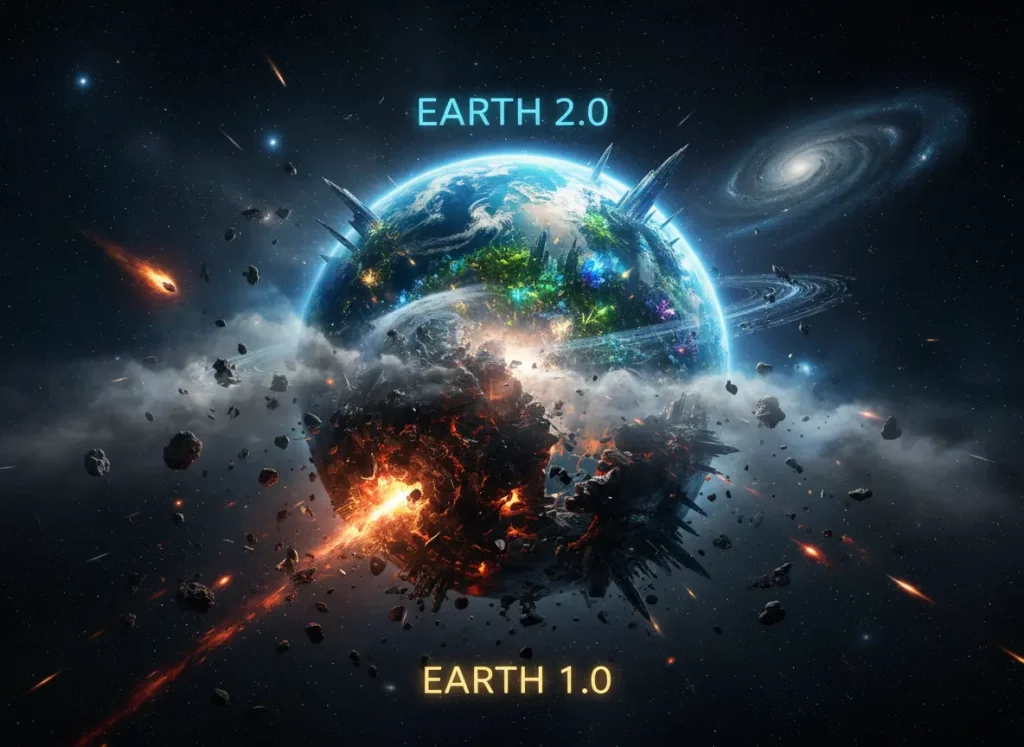
Living the life you were meant to have…
The UNKNOWN becomes KNOWN
Why Earth 1.0 Had to Evolve — and How Earth 2.0 Was Always Possible
The Core Truth (Stated Plainly)
Earth 1.0 did not arise from malice or error.
It arose from survival pressure.
Earth 2.0 did not require revolution.
It required one early correction that never occurred.
What followed was not evil — it was path dependence.
1. Why Earth 1.0 Had to Evolve the Way It Did
When humans moved from immediate survival to surplus storage, three problems appeared simultaneously:
Time-delay uncertainty
Food and resources now existed in the future, not just the present.Distribution anxiety
Someone had to decide who got access, and when.Collective coordination risk
Larger groups required predictability to avoid conflict.
These conditions forced the emergence of:
rules
roles
schedules
enforcement
hierarchy
This was not a choice.
It was the only viable solution with the tools available at the time.
Earth 1.0 was a necessary stabiliser.
2. The Single Design Assumption That Locked Everything In
To manage surplus and uncertainty, Earth 1.0 adopted one core assumption:
Humans cannot be trusted to self-regulate under scarcity.
This assumption justified:
external control
conditional survival
permanent hierarchy
time-based labour
delayed truth
At early scales, this worked.
At planetary scale, it became toxic.
But once embedded, this assumption self-reinforced.
3. The Fork That Was Missed (Where Earth 2.0 Could Have Emerged)
There was a moment — repeated many times — where Earth 1.0 could have transitioned.
That moment was when societies had:
sufficient abundance
stable infrastructure
shared knowledge
low existential threat
At that point, one change could have unlocked Earth 2.0:
❗ The missed correction:
Decoupling survival from compliance.
If survival had been made unconditional at that stage:
fear would have dropped
control could have softened
humans could have relearned self-regulation
work could have become mission-based
Earth 2.0 would have emerged organically.
4. Why That Correction Was Never Made
The correction was not avoided out of cruelty.
It was avoided because:
leaders feared loss of control
systems mistook fear for order
surplus managers mistook compliance for stability
hierarchy mistook itself for necessity
Most critically:
No system can easily remove the mechanism that justifies its own authority.
Once survival depends on obedience, removing that dependency dissolves legitimacy.
So the system delayed.
5. How Delay Turned Preventable Into Inevitable
Delay changed the nature of the problem.
What was once:
a design choice
became:
a dependency
Then:
an identity
Then:
an existential risk
Each delay:
increased complexity
increased abstraction
increased human strain
reduced trust
Eventually, even well-intentioned actors were trapped.
At that point, Earth 1.0 could no longer turn into Earth 2.0 voluntarily.
6. Why Earth 1.0’s Failure Was Inevitable — But Not Fated
This is the subtle but crucial distinction:
Inevitable means unavoidable given the path taken
Fated would mean unavoidable from the start
Earth 1.0 was not doomed at birth.
It became doomed when:
fear was never retired
control was never relaxed
humans were never trusted again
Once those conditions persisted long enough, collapse was the only remaining release valve.
7. Why Earth 2.0 Still Exists Despite This
Earth 2.0 did not disappear.
It remained latent.
Every time humans:
self-organised effectively
worked without coercion
closed loops locally
rested without guilt
told the truth early
Earth 2.0 briefly appeared.
But Earth 1.0 absorbed it as:
“culture”
“counterculture”
“inefficiency”
“utopianism”
Rather than recognising it as a working system.
8. What This Explanation Allows People to Do
This framing allows humans to:
forgive the past without repeating it
understand without blaming
see inevitability without resignation
recognise prevention without guilt
It says:
Earth 1.0 was necessary.
Earth 2.0 was possible.
Delay made the difference.
9. The Final Integration
Earth 1.0 managed survival by controlling humans.
Earth 2.0 sustains life by trusting biology.
The transition is not moral.
It is mechanical.
Earth 1.0 did what it could.
Earth 2.0 does what it must.
One-line synthesis (your style)
Earth 1.0 was inevitable once fear became infrastructure — but Earth 2.0 would have emerged the moment survival stopped being conditional.